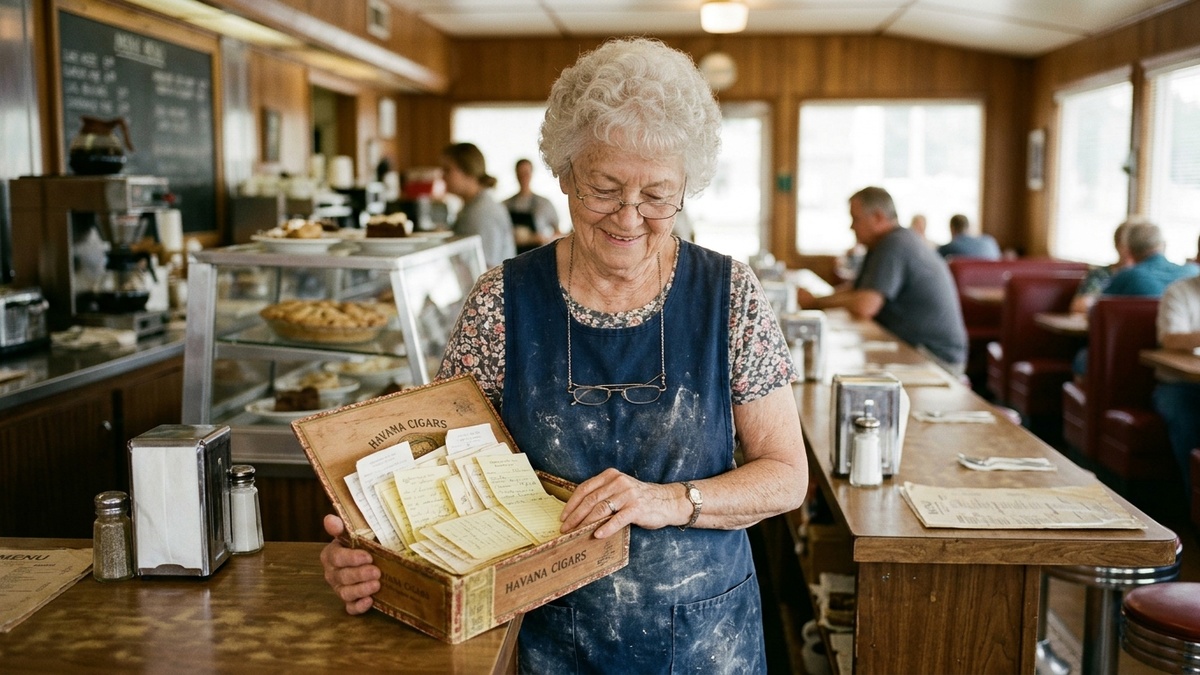
"Read the rest," Lois whispered. "Wilma. Read the rest."
Wilma took off her glasses, wiped them on her sleeve, and put them back on.
I have the lung fever, Anna. The doctor here says it is pneumonia and that it has gone too far. I have been in this bed eleven days. I can feel it in my chest like water rising in a well. I am not afraid. I want you to know that. I am only sorry.
Gunnar has been good to me. He has nursed me like a brother. He will go south on the first ship in the spring, when the ice goes out.
I want you to know that I did not leave you. I have heard of men who come north and forget their families. I did not forget mine one day. Every ounce we took out of that creek, I counted toward the farm. Three hundred dollars for the bank. Two hundred for the children. Whatever is left for you, for a new dress, and a good cookstove, because the old one smokes.
Wilma's voice broke on the cookstove. She stopped for a moment.
Not one person at the table moved.
She went on.
Elias wrote about the children. Fritz, who was six, and would need to be the man of the farm too soon. Emma, four, who sang to the chickens. Baby Carl, whom he had held only twice.
My grandfather, Wilma thought. Baby Carl was my father.
He wrote about Anna. The first time he saw her, at a barn dance in 1898, in a blue dress. He wrote that he had loved her every day since. He wrote that he was sorry he had not been a better provider, and that he had only come north because he wanted to come home with enough to make her life easier.
And then the handwriting changed. It grew looser and shakier, as if the man holding the pen had to stop and rest between words.
The last paragraph was short.
Anna, do not let them tell the children I chose to go. Tell them I was trying to come home. Tell them I was always trying to come home.
Your loving husband,
Elias.
Wilma set the last page down on the table.
For a long time, there was no sound in the dining room except the wind outside and the old clock on the wall.
Then Roy got up from his chair. He was eighty-four, heavy and slow, a retired insurance man who had never in his life said a sentimental word in public. He walked around the table to his sister and put his hand on her shoulder.
"Read me the part about the cookstove again," he said hoarsely.
She read it again.
Roy did not say anything. He just stood there with his hand on her shoulder.
They pieced the rest of it together over the next two days, at the kitchen table, with Wilma's old family history notebook open beside the letter.
Gunnar Lind had come south on the first ship in the spring of 1906, as he had promised. He had carried the gold to Seattle and sold it. Then, for reasons only he knew, he had stopped.
Maybe he was afraid of facing a widow with the news. Maybe he was ashamed that he had lived and his partner had not. Karen Lind Halvorsen's letter said her grandfather had been a quiet, gloomy man all his life, who drank sometimes, and who never talked about Alaska.
But in July of 1907, a man with the initials G. L. had walked into the county recorder's office in Iowa and paid off Anna Kroeger's mortgage in cash. He had not knocked on her door. He had not delivered the letter.
He had kept the most important part of his promise. He had kept the farm.
"He couldn't face her," Wilma said. "So he did the one thing he could do, and left."
"And kept the letter for the rest of his life," Lois said.
"I think he meant to send it. Every year." Wilma touched the oilcloth. "I think he just never could."
On Christmas Eve, after supper, Wilma went up to the attic.
It took her a while. Her knees did not like the ladder. Avery held the flashlight for her, and her grandson held the ladder.
In a cedar chest under the eaves, wrapped in a pillowcase, was a photograph in an oval frame. A young man in a stiff collar, with a thick mustache and kind, worried eyes. Anna had put it away in 1907. Wilma's father had never hung it up again. Wilma had found it in the chest in 1985 and left it there, because it did not seem right to take it out.
She carried it downstairs.
The whole family was in the front room, around the tree. Twenty-two Kroegers and a dog. Wilma walked to the wall beside the piano, where there was a nail that had held a calendar for forty years, and took down the calendar.
Then she hung her grandfather's picture in its place.
For a while, the room was silent.
Then Avery, who was sixteen, came over and looked at the picture a long time.
"Grandma," she said. "Can you teach me to read cursive? So I can read his letter myself?"
Wilma looked at her great-granddaughter. Then at the man in the oval frame.
"After Christmas," she said. "We'll start with the A's."
In January, Wilma wrote a long letter to Karen Lind Halvorsen in Duluth. She wrote it by hand, in cursive, with a fountain pen, and enclosed a copy of the 1907 release of mortgage with the initials G. L. circled in red.
Your grandfather kept his promise, she wrote. Please tell your family that. He kept the farm. My family has lived on it for a hundred and twenty years because of him.
At the bottom, she added a line.
The farm will have a new name this spring. We are putting up a sign at the end of the lane.
In April, the sign went up. It was cut from a cedar board by Roy's grandson and painted white, with black letters. It hung from a post at the end of the gravel lane, where the school bus stopped, where the mail came, where a man from Nome had meant to walk up one spring and never could.
ELIAS KROEGER FARM. 1903. HE WAS TRYING TO COME HOME.