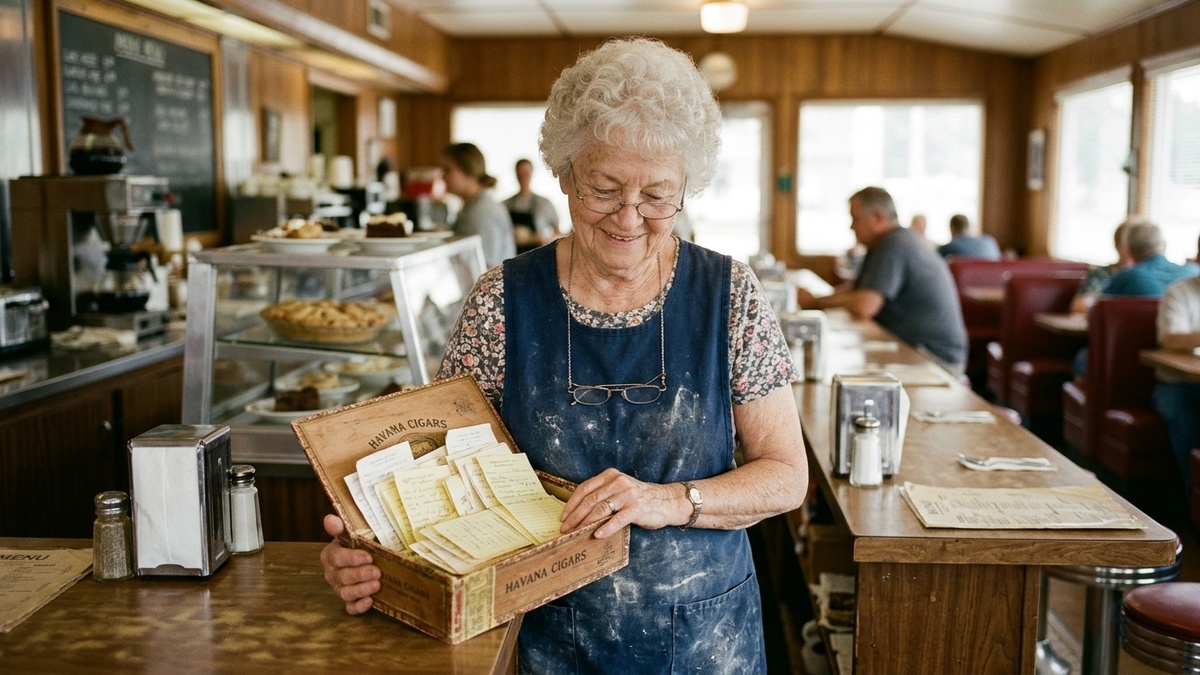
Norma Fultz had not seen Jim Calloway in fifty-eight years, and when he walked into the Christmas craft fair at the Tippecanoe Bend fairgrounds and stopped dead in front of her pie table, she dropped a whole sugar cream pie on the concrete floor.
It landed upside down. The tin rang like a bell.
Jim looked down at it. Then he looked up at her.
"Norma," he said.
"Jim," she said.
Then she did the only thing she could think of. She bent down, picked up the ruined pie, and carried it out the side door of the exhibit hall into the cold, and did not come back for twenty minutes.
Norma was seventy-six. She had baked pies for the Tippecanoe Bend fair since 1966, summer and Christmas, and had won the blue ribbon for sugar cream pie thirty-one times. She had been married forty-four years to a good man named Dale Fultz, a seed corn salesman, who had died in 2013. She had two sons, five grandchildren, and a kitchen in the farmhouse outside Tippecanoe Bend, Indiana, where her mother's rolling pin still hung on a nail by the stove.
She had not thought about Jim Calloway in years.
That was a lie. She had thought about him every August, when the fair came around, and every time she passed the Ferris wheel lot on the north side of the fairgrounds, where he had kissed her for the first time in 1967.
Her sister Arlene was running the jam table beside hers. Arlene was eighty-one, five years older, and had never in her life let a thing go without comment.
"You dropped a pie," Arlene said, when Norma came back in.
"I know I dropped a pie."
"Was that Jim Calloway?"
"You know it was."
Arlene was quiet a moment. She rearranged three jars of apple butter that did not need rearranging.
"He's back from Oregon," she said. "His wife died last spring. He moved into his brother's old house on County Road 400."
Norma looked at her sister. "How do you know that?"
"Half the church knows that."
"I go to the same church, Arlene."
"You sit on the other side," Arlene said, and went back to her jars.
The story of Norma and Jim was not a long one, but it had taken up a large piece of her life.
They had gone together for two years, from 1966 to 1968. He was a quiet farm boy who fixed tractors and played second base. She was the girl who baked the pies. In June of 1968, he was drafted, and he went to basic training at Fort Leonard Wood in Missouri.
Before he left, they sat on the tailgate of his father's pickup by the Ferris wheel lot, and he told her he would write every week.
He did. Every Monday, a letter. For ten weeks.
Then, in September of 1968, the letters stopped.
She wrote him four more times. No answer. In November, his mother told her at the grocery store that Jim had found a girl from Oregon near his Army post and was going to marry her.
Norma had gone home and burned his letters in the stove. All forty of them.
She married Dale in 1969. She had never once regretted it. Dale was a kind man and a good father, and she had loved him.
But she had never understood why Jim stopped writing. And she had never asked.
On Saturday afternoon, on the second day of the fair, Jim came back to her table.
He bought a pie. Sugar cream. He paid with a ten-dollar bill and told her to keep the change. Then he stood there holding the pie in its white box, looking at her, as if he had something to say and could not find the front of it.
"You still make it with the cream poured right in the shell," he said finally. "No eggs."
"That's the only way to make it."
"My wife tried for forty years. She never could get it right." He smiled a little. "She used eggs."
Norma did not know what to say to that, so she said nothing.
"Norma," Jim said. "Can I ask you something? I've wanted to ask for fifty-eight years."
"Go ahead."
"Why did you stop writing?"
Norma stared at him.
"I didn't stop writing," she said. "You did."
They stood there for a long time, the two of them, in the middle of the exhibit hall, with Christmas music playing over the loudspeaker and a woman at the next table selling crocheted snowmen.
"I wrote you every Monday," Jim said slowly. "From Fort Leonard Wood. And from Fort Lewis, after. I wrote you all fall. You never wrote back."
"I wrote you four times after your letters stopped."
"I never got them."
"I never got yours."
They looked at each other.
Then, very slowly, they both turned and looked at the next table, where Arlene was standing behind her apple butter with her hands folded in front of her, and her face had gone the color of skim milk.
Arlene did not say a word. She took off her apron and folded it into a neat square on the table. Then she picked up her purse and walked out of the exhibit hall into the parking lot, without her coat, in the snow.
Norma went after her.
She found her sister sitting in her old Buick at the far end of the lot with the engine off, staring straight ahead through the windshield. Norma opened the passenger door and got in.
It was very cold in the car. Neither of them spoke for a while.
"Arlene," Norma said finally. "In 1968, you worked at the post office."
"I did," Arlene said.
She was still staring through the windshield. Her hands were shaking on the steering wheel.
"I sorted the mail for the rural routes," she said. "Every morning at five. Including ours."